
A body mass index converter is a simple way to understand how your weight relates to your height. Many people in the USA and Canada use BMI as a quick health calculator because it gives a general weight category in seconds. It is not a full medical test, but it can help adults, parents, and teens start a more informed conversation about health.
Health professionals commonly use BMI as a screening tool. It does not measure body fat directly, nor does it account for muscle mass, body shape, age, sex, ethnicity, or personal health history. Still, when used carefully, it can be a helpful first step.
In this guide from Open Talk Magazine, you will learn what body mass index means, how to calculate BMI body mass index, how to use a converter, and how adults and teens should understand the results.
What Is Body Mass Index?
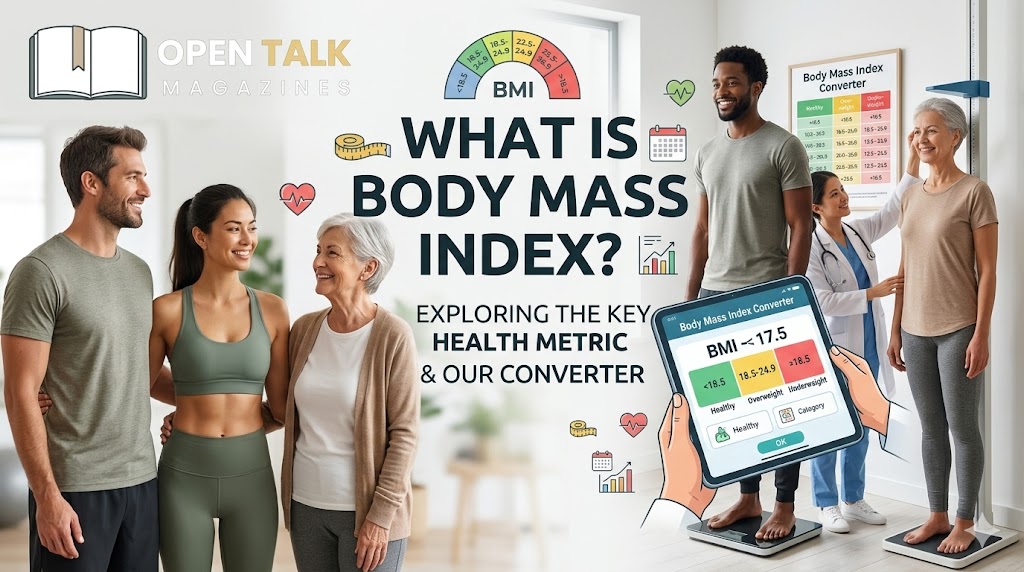
Body mass index, or BMI, is a number calculated from your height and weight. It helps estimate whether your weight falls within a general range, such as underweight, healthy weight, overweight, or obese.
The main idea is simple. BMI compares body weight to height. A taller person can usually weigh more than a shorter person and still fall within the same BMI range.
BMI is often used because it is quick, affordable, and easy to understand. You do not need lab tests or medical equipment to calculate it. You only need your height and weight.
However, BMI is not a diagnosis. It is a screening number. A health professional may also look at waist size, blood pressure, lab results, lifestyle, family history, and overall health before making any health recommendation.
Why Use a Body Mass Index Converter?

A body mass index converter makes BMI easier to calculate because it can work with different units. In the USA, many people use pounds, feet, and inches. In Canada, many people also use kilograms and centimeters.
A converter helps you avoid manual math and unit mistakes.
You may use a BMI converter to:
- Check your BMI quickly
- Convert height and weight into a BMI score
- Understand your general BMI category
- Track general health changes over time
- Prepare for a conversation with a doctor
- Compare metric and imperial measurements
A BMI converter is useful for adults, but teens need a different type of BMI interpretation. Adult BMI categories are not the same as teen BMI categories.
How to Calculate Body Mass Index

If you want to know how to calculate body mass index, the formula depends on the units you use.
BMI Formula for Pounds and Inches
Use this formula if you measure weight in pounds and height in inches:
BMI = weight in pounds ÷ height in inches² × 703
For example, if a person weighs 160 pounds and is 5 feet 7 inches tall, first convert the height to inches.
- 5 feet 7 inches = 67 inches
Then calculate:
- 160 ÷ 67² × 703 = 25.1
- That person’s BMI is about 25.1.
BMI Formula for Kilograms and Meters
Use this formula if you measure weight in kilograms and height in meters:
BMI = weight in kilograms ÷ height in meters²
For example, if a person weighs 70 kg and is 1.75 meters tall:
- 70 ÷ 1.75² = 22.9
- That person’s BMI is about 22.9.
How to Calculate Your Body Mass Index Step by Step
Here is a simple method:
- Measure your current weight.
- Measure your current height.
- Choose the right formula.
- Enter the numbers into a BMI calculator.
- Read the BMI result.
- Check the correct BMI category for your age group.
For adults, BMI categories are based on fixed number ranges. For teens, BMI depends on age and sex because bodies grow at different rates during development.
Adult BMI Categories
For adults aged 20 and older, BMI is usually grouped into these categories:
Category
- Underweight
- Healthy weight
- Overweight
- Obesity
BMI Range
- Below 18.5
- 18.5 to 24.9
- 25.0 to 29.9
- 30.0 and above
These categories are used as general guidance. They do not tell the full story of a person’s health.
For example, a very muscular adult may have a higher BMI without having high body fat. Another person may have a normal BMI but still have health risks due to waist size, diet, stress, sleep, or family history.
BMI for Teens: What Makes It Different?
Teen BMI is different from adult BMI because teens are still growing. A 13-year-old, a 16-year-old, and a 19-year-old can have different growth patterns, even if their height and weight look similar.
For teens, BMI is usually compared with that of other teens of the same age and sex. This is called BMI-for-age percentile.
Teen BMI results often fall into categories based on percentiles, not fixed adult numbers.
This is why teens should not use adult BMI categories as their final answer. A teen BMI calculator or pediatric growth chart is more appropriate.
Body Mass Index Converter for Adults vs Teens
A good body mass index converter should make the age difference clear.
For adults, the converter can show a BMI number and an adult BMI category.
For teens, the converter should ask for the following:
- Age
- Sex
- Height
- Weight
This helps estimate the BMI percentile more accurately.
Parents and teens should use teen BMI results carefully. Growth, puberty, sports, muscle, and medical conditions can affect weight. If there are concerns, it is best to speak with a pediatrician or qualified healthcare provider.
BMI Calculator for Women
Many people search for a BMI calculator for women, but the standard adult BMI formula is the same for adult men and women. The calculation uses height and weight, not gender.
However, BMI may not explain everything about women’s health. Pregnancy, postpartum changes, muscle mass, menopause, and body composition can all affect weight and health.
A BMI calculator for women can give a general number, but it should not replace medical advice. Women should also consider other health markers such as energy levels, blood pressure, cholesterol, waist measurement, menstrual health, and doctor recommendations.
Is BMI a Complete Health Calculator?
BMI is a helpful health calculator, but it is not complete on its own.
It does not directly measure the following:
- Muscle mass
- Bone density
- Body fat percentage
- Waist size
- Fitness level
- Nutrition quality
- Sleep habits
- Stress levels
- Medical history
This is why BMI should be seen as a starting point, not a final health score.
A better health picture may include BMI along with waist measurement, activity level, diet quality, blood pressure, blood sugar, cholesterol, and advice from a healthcare professional.
When BMI Can Be Misleading
BMI may be less accurate for some people, including
- Athletes with high muscle mass
- Older adults who have lost muscle
- Pregnant people
- Teens are going through growth changes
- People with different body frames
- People with certain medical conditions
For example, an athlete may have a BMI in the overweight range because muscle weighs more than fat. That does not automatically mean poor health.
On the other hand, someone with a normal BMI may still have health risks if they have high abdominal fat, poor nutrition, or low physical activity.
How Often Should You Check BMI?
Most people do not need to check their BMI every day. Weight naturally changes due to water, meals, hormones, sleep, and activity.
For general awareness, checking BMI every few months may be enough. If you are working with a doctor, follow their advice.
For teens, frequent weight checking can become stressful. Teen BMI should be used with care and support, not pressure or judgment.
Tips for Using a Body Mass Index Converter Correctly
To get a better result, use accurate measurements.
Helpful tips include:
- Measure height without shoes
- Use a reliable scale
- Weigh at a consistent time of day
- Enter the correct units
- Use adult BMI only if you are 20 or older
- Use teen BMI percentile tools for ages 2 to 19
Small errors in height or weight can change the BMI number, especially for shorter people.
What to Do After You Get Your BMI Result
Your BMI result should guide awareness, not fear.
If your BMI is outside the healthy range, do not panic. It only means you may benefit from a closer look at your overall health.
You can consider:
- Talking with a doctor
- Reviewing eating habits
- Moving more in a safe way
- Improving sleep
- Managing stress
- Checking blood pressure
- Asking about other health markers
The goal is better health, not chasing a number.
Body Mass Index Converter for USA and Canada Users
People in the USA often enter weight in pounds and height in feet and inches. People in Canada may use either imperial or metric units.
A useful body mass index converter should support both systems.
For USA users:
- Weight: pounds
- Height: feet and inches
For Canada users:
- Weight: kilograms or pounds
- Height: centimeters or feet and inches
This makes the tool easier for families, students, fitness users, and healthcare readers across both countries.
Why BMI Still Matters
BMI has limits, but it remains useful because it is simple and widely understood. It helps people identify possible weight-related health risks and encourages early conversations about wellness.
It is especially helpful when used with other information. A single BMI number should never define a person. But it can help someone ask better questions about their health.
Conclusion
A body mass index converter is a fast and simple tool for adults and teens who want to understand BMI practically. It helps convert height and weight into a general BMI number, but the result should always be used with context.
Adults can use standard BMI categories, while teens should use BMI-for-age percentiles. A BMI calculator for women uses the same basic formula, but women’s health needs may require a broader view.
BMI is best used as a starting point. For a complete health picture, consider lifestyle, body composition, medical history, and guidance from a qualified healthcare provider.
FAQs
Q1: What is a body mass index converter?
A1: A body mass index converter is a tool that calculates BMI from your height and weight.
Q2: How do I calculate BMI, body mass index?
A2: You calculate BMI by dividing weight by height squared, using either the metric or imperial formula.
Q3: Is BMI accurate for teens?
A3: Teen BMI should be checked by age and sex percentile, not adult BMI categories.
Q4: Can adults use the same BMI chart?
A4: Yes, adults aged 20 and older usually use standard BMI categories.
Q5: Is a BMI calculator for women different?
A5: The formula is the same, but women may need extra health context beyond BMI.
Q6: Is BMI a medical diagnosis?
A6: No, BMI is a screening tool and should not replace professional medical advice.
Q7: What is a healthy BMI for adults?
A7: For most adults, a BMI from 18.5 to 24.9 is considered a healthy weight range.
Q8: Can BMI be wrong for athletes?
A8: Yes, BMI may be misleading for athletes because muscle can increase body weight.