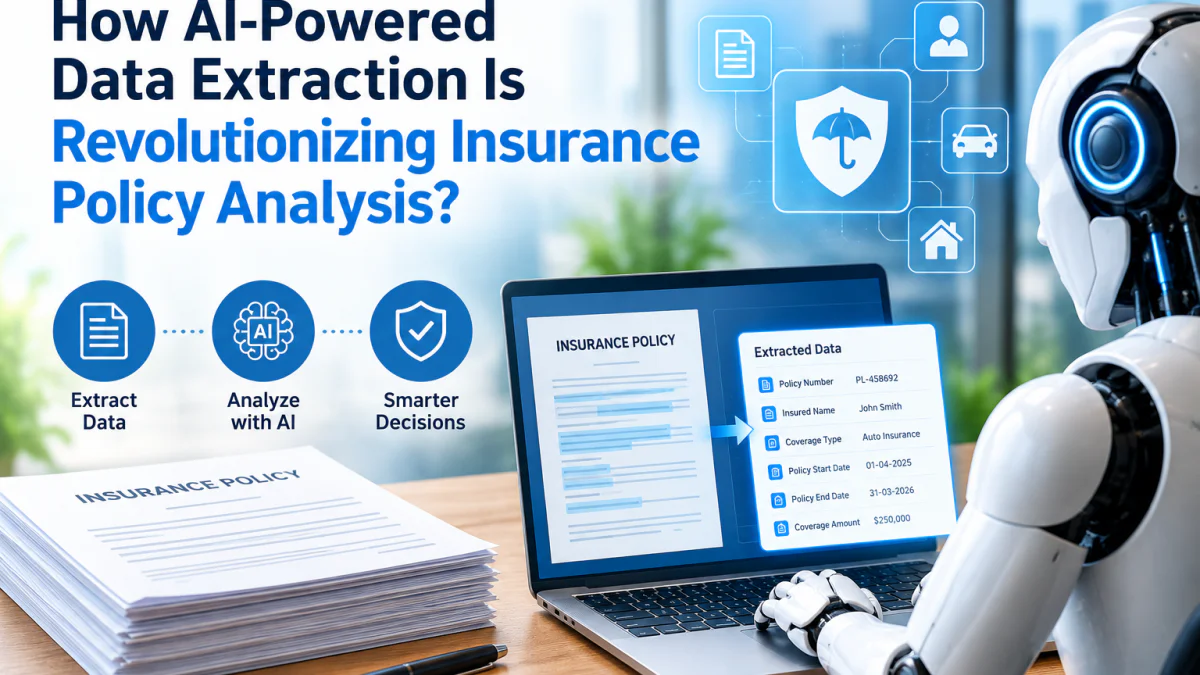
The insurance industry has always been data-driven. From policy documents and applications to endorsements, claims, certificates, and renewal records, insurance professionals work with enormous volumes of information every day. However, much of this information remains locked inside unstructured documents such as PDFs, scanned forms, emails, spreadsheets, and policy schedules.
Traditionally, extracting and analyzing this information has required significant manual effort. Insurance teams spend hours locating relevant information, entering data into systems, comparing policy details, and verifying coverage. This process can be time-consuming, costly, and vulnerable to human error.
AI-powered data extraction is changing this landscape. By combining artificial intelligence, machine learning, optical character recognition (OCR), and intelligent document processing, insurers and insurance service providers can automatically extract, organize, validate, and analyze critical policy information.
For insurance organizations looking to improve efficiency and accuracy, AI is becoming an important enabler of smarter insurance policy analysis.

What Is AI-Powered Data Extraction?
AI-powered data extraction uses artificial intelligence technologies to identify and extract relevant information from structured and unstructured documents.
Unlike traditional OCR, which primarily converts images into machine-readable text, AI-powered extraction understands the context and meaning of the information within a document.
For example, an insurance policy may contain information about:
- Policyholder and insured details
- Policy numbers
- Effective and expiration dates
- Coverage limits
- Deductibles
- Premiums
- Exclusions
- Endorsements
- Locations
- Vehicles, properties, or other insured assets
- Additional insureds
- Named insureds
- Coverage conditions
AI can identify these fields even when they appear in different locations, formats, or layouts across documents.
This capability allows insurance organizations to move beyond simple data capture toward intelligent document understanding.
Why Insurance Policy Analysis Is Challenging?
Insurance policies are rarely standardized across carriers. Different insurance companies may use different document formats, terminology, layouts, and coverage structures.
A single account can include multiple policies and documents, each containing hundreds of data points. An insurance professional may need to review these documents to understand coverage, identify differences, verify limits, and prepare recommendations.
Manual insurance policy analysis creates several challenges:
1. Time-Consuming Manual Review
Employees may spend hours reviewing policy documents and manually entering information into spreadsheets or insurance systems.
2. Human Errors
Manual data entry can result in incorrect policy numbers, limits, dates, premiums, or other critical information.
3. Inconsistent Data
When information is extracted manually by different employees, formatting and interpretation can vary.
4. Difficulty Comparing Policies
Comparing policies from multiple carriers requires information to be standardized before meaningful analysis can take place.
5. Limited Scalability
As the volume of policies increases, organizations must either increase their workforce or find more efficient ways to process documents.
AI-powered technologies address many of these challenges by automating repetitive document-processing activities.
How AI-Powered Data Extraction Improves Policy Analysis?
The value of AI-powered data extraction goes beyond simply reducing manual data entry. It can transform the entire policy review workflow.
Automated Information Capture
AI can process large volumes of insurance documents and automatically identify relevant policy information. This reduces the need for employees to manually search through lengthy documents.
Intelligent Document Classification
AI can identify different document types, including declarations pages, endorsements, schedules, applications, certificates, and policy forms.
This helps route documents to the appropriate processing workflow.
Context-Aware Data Extraction
AI models can understand relationships between data elements. For example, they can distinguish between a policy effective date and an endorsement effective date rather than simply extracting every date appearing on a page.
Standardization of Information
Information extracted from different carriers can be mapped into standardized fields. This makes it easier for insurance professionals to compare policies and identify differences.
Faster Policy Comparison
Once policy data has been extracted and standardized, AI can help identify differences in coverage limits, deductibles, premiums, exclusions, and other policy attributes.
This enables insurance professionals to spend more time on analysis and client service rather than document processing.
AI Insurance Verification: Improving Accuracy and Compliance
Another important application is AI insurance verification.
Insurance organizations frequently need to verify whether policy information is accurate, complete, and consistent across documents.
AI can assist by comparing extracted information against predefined rules, reference data, or other documents.
For example, AI can flag potential discrepancies such as:
- Mismatched policy dates
- Differences in coverage limits
- Missing endorsements
- Inconsistent insured names
- Incorrect or missing policy numbers
- Unexpected changes in deductibles
- Missing required information
Instead of requiring employees to manually identify every discrepancy, AI can highlight areas that require attention.
This creates a more efficient AI insurance verification process while keeping human professionals involved in important decisions.
The Role of AI Insurance Solutions in Modern Insurance Operations
The adoption of AI insurance solutions is expanding across the insurance value chain.
Insurance brokers, carriers, MGAs, TPAs, and insurance service providers can use AI to automate document-heavy processes while improving operational efficiency.
AI insurance solutions can support activities such as:
- Policy data extraction
- Quote comparison
- Policy verification
- Document classification
- Claims document processing
- Renewal preparation
- Certificate processing
- Submission management
- Data validation
- Risk information analysis
The objective is not simply to replace manual work. Instead, AI enables insurance professionals to focus on higher-value activities such as risk assessment, client communication, coverage evaluation, and decision-making.
Benefits for Insurance Brokers and Teams
For insurance brokers, the impact of AI-powered document processing can be significant.
- Increased Productivity
Automating repetitive extraction and validation tasks allows employees to process more accounts without proportionally increasing manual effort.
- Improved Accuracy
AI can reduce errors associated with repetitive data entry and document review.
- Faster Turnaround Times
Automated extraction can accelerate policy processing, quote comparison, and renewal preparation.
- Better Client Experience
When employees spend less time on administrative tasks, they can respond to clients more quickly and focus on providing meaningful insurance advice.
- Improved Operational Scalability
AI allows organizations to handle increasing document volumes without relying entirely on additional manual resources.
Human Expertise and AI: A Powerful Combination
AI is highly effective at processing large volumes of information, but human expertise remains essential in insurance.
Insurance professionals bring industry knowledge, judgment, context, and experience that are critical when interpreting coverage and advising clients.
The most effective approach is therefore a human-in-the-loop model.
AI can extract and organize information, identify potential discrepancies, and highlight important data points. Insurance professionals can then review the results, validate exceptions, and make informed decisions.
This combination allows organizations to achieve both automation and quality control.

What the Future Holds?
The future of insurance operations will increasingly depend on intelligent automation.
As AI models become more capable of understanding complex insurance terminology and document structures, organizations will be able to automate increasingly sophisticated workflows.
The evolution will move from:
Document Processing → Data Extraction → Data Validation → Policy Analysis → Intelligent Insights
This progression can help insurance organizations build faster, more connected, and data-driven workflows.
For companies investing in digital transformation, AI-powered data extraction is becoming an important foundation for modern insurance operations.
Conclusion
Insurance organizations process vast amounts of information every day, and traditional manual approaches can make policy analysis slow, expensive, and difficult to scale.
AI-powered data extraction provides a smarter way to capture, organize, validate, and analyze insurance information. By automating document-heavy activities, organizations can improve accuracy, accelerate processing, and enable employees to focus on higher-value insurance activities.
Combined with AI insurance verification and broader AI insurance solutions, intelligent data extraction can transform how insurance teams work with policy information.
At Exdion Insurance Solutions, we understand the importance of combining insurance expertise with intelligent technology to help organizations streamline document-intensive workflows and unlock greater value from their data.
The future of insurance policy analysis is not just about processing documents faster—it is about turning insurance data into actionable intelligence.
AI-powered data extraction is helping make that future a reality.