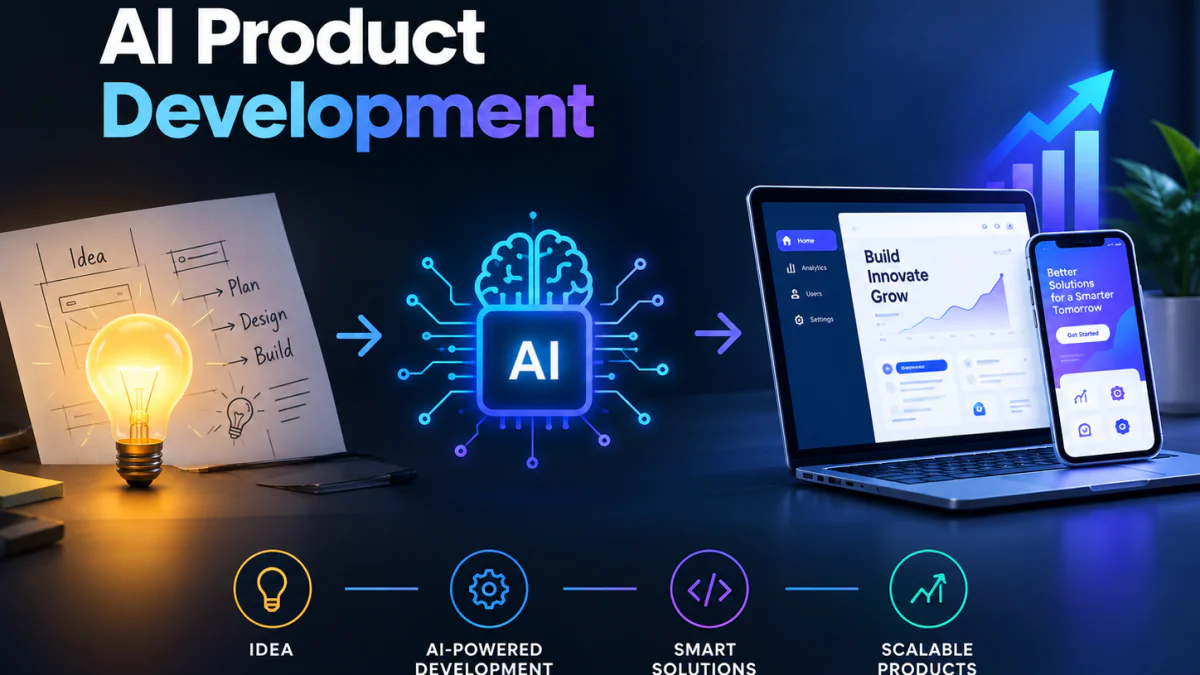
Turning an innovative idea into a successful digital product requires more than writing code. Businesses need to validate the concept, understand users, select the right technology, build a reliable product, and continuously improve it after launch. Artificial intelligence is changing how companies approach each of these stages.
AI Product Development combines artificial intelligence with product strategy, software engineering, data, and user experience to create applications that can learn from information, automate processes, generate insights, and adapt to changing user needs. When planned correctly, it can help organizations transform early-stage ideas into scalable digital products.
Why AI Is Becoming Part of Modern Product Development
Traditional software generally follows predefined rules. AI products can process large amounts of data and produce outputs based on patterns, models, and user interactions.
This makes AI useful for products that involve recommendations, automation, prediction, natural language processing, computer vision, or intelligent decision-making.
However, adding AI simply because it is popular does not guarantee a better product. The technology should solve a genuine user problem and provide measurable value.
From Idea to Product: The Key Development Stages
1. Define the Problem and Target Users
Every successful product starts with a clear problem. Before selecting an AI model or technology stack, teams should identify who will use the product, what challenges they face, and how the proposed solution can improve their experience.
A clear problem statement also helps determine whether AI product is actually necessary or whether traditional software would be more appropriate.
2. Validate the AI Use Case
Not every product requires machine learning or generative AI. During validation, teams can examine factors such as available data, expected outcomes, technical feasibility, privacy requirements, and potential return on investment.
This stage can prevent businesses from spending resources on AI features that do not provide meaningful value.
3. Build a Practical MVP
Instead of attempting to develop a complete platform immediately, teams can create a minimum viable product (MVP) containing the most important functionality.
For example, an AI-powered business application might initially focus on one automation workflow, recommendation feature, or conversational interface. User feedback from the MVP can then guide future development.
The Role of AI Software Development
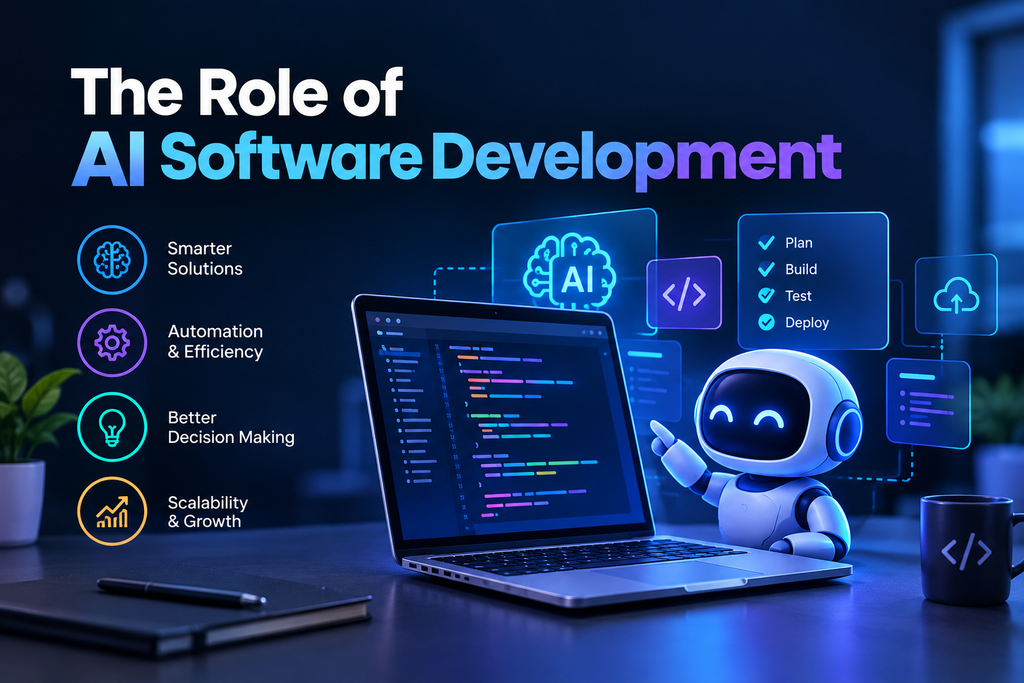
AI Software Development involves integrating intelligent capabilities into reliable software systems. This can include selecting models, developing APIs, managing data pipelines, designing interfaces, and connecting AI functionality with existing business systems.
A strong architecture should also consider scalability from the beginning. AI workloads can require significant computing resources, particularly when applications process large datasets or serve many users simultaneously.
Cloud infrastructure, efficient APIs, caching, monitoring, and modular architecture can help applications handle increasing demand without unnecessary complexity.
Building Intelligent User Experiences
AI Application Development
AI Application Development focuses on turning AI capabilities into practical applications that users can interact with. Examples include intelligent search, virtual assistants, recommendation systems, document analysis, predictive tools, and automated workflows.
The user experience is particularly important because AI outputs are not always predictable. Applications should provide clear feedback, appropriate error handling, and ways for users to review or correct results when necessary.
For business applications, transparency can also help users understand when AI is being used and when human review is involved.
Designing for Long-Term Scalability
AI Product Engineering
AI Product Engineering goes beyond building an initial AI feature. It considers the entire product lifecycle, including architecture, data management, model integration, testing, security, monitoring, and continuous improvement.
As usage increases, teams may need to optimize model performance, reduce infrastructure costs, improve response times, and introduce new capabilities. A modular engineering approach makes these changes easier to manage.
Testing is another important consideration. AI products should be evaluated not only for technical reliability but also for accuracy, consistency, security, and performance across different real-world scenarios.
Where Custom AI Solutions Can Add Value
Custom AI Solutions can be useful when standard software does not adequately address a company’s specific workflow or data requirements.
For example, an organization might develop an AI system to analyze internal documents, automate repetitive processes, identify patterns in customer interactions, or assist employees with specialized tasks.
The goal should not be to make every process “AI-powered.” Instead, organizations should identify areas where intelligent automation can produce a clear and measurable improvement.
Practical Steps for Building a Scalable AI Product
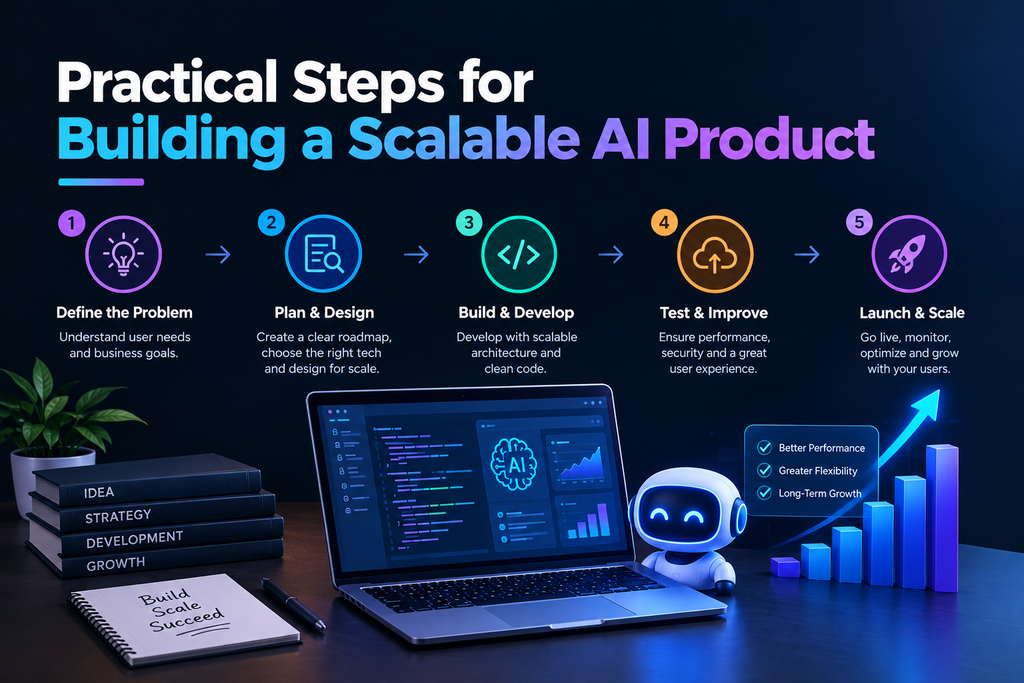
A practical development approach can include:
- Identify a specific user problem and define measurable objectives.
- Evaluate the available data and determine whether it is sufficient for the intended AI functionality.
- Choose the appropriate technology, model, and architecture based on the product requirements.
- Develop an MVP to test the core concept with real users.
- Measure performance using relevant technical and business metrics.
- Collect user feedback and improve the product based on actual usage.
- Plan for security and scalability before expanding the user base.
- Monitor the AI system continuously after deployment to identify performance issues and changing requirements.
This iterative approach allows businesses to learn before making large investments and reduces the risk of building technology that users do not need.
The Future of AI-Driven Digital Products
AI is increasingly becoming a component of broader digital product strategies rather than an isolated technology. Businesses are exploring intelligent automation, AI assistants, predictive analytics, personalized experiences, and agent-based workflows across different industries.
Companies such as CodeCones approach AI and software development by combining product thinking with engineering and modern technology practices. For organizations exploring an AI-based product, working through the problem, architecture, MVP, and scalability requirements systematically can create a stronger foundation for long-term development.
Conclusion
AI is changing how digital products are imagined, developed, and improved. However, successful AI products are not created simply by adding an AI model to an existing application. They require a clear problem, suitable data, thoughtful architecture, reliable engineering, user-focused design, and continuous evaluation.
For businesses with a strong use case, AI Product Development can provide a practical path from an early idea to an intelligent, scalable digital product. Starting small, validating assumptions, and designing for long-term growth can help turn promising concepts into solutions that deliver lasting value.